Learn what RoIP, or Radio over IP, means, how it works, and how it helps extend radio coverage, connect different radio systems, and support reliable push-to-talk communications.
RoIP, or Radio over IP, is a way to send push-to-talk radio communications over an IP network such as the internet, a private network, mobile data, or satellite. It helps radio users communicate across longer distances and connect different radio systems without replacing the radios they already use.
In simple terms, RoIP turns a radio call into digital data, moves it across a network, and turns it back into radio audio at the other end. To the user, it still feels like normal push-to-talk radio.
Quick answer: RoIP extends radio coverage, improves interoperability between different radio systems, supports dispatch operations, and helps organizations keep communication moving during incidents, outages, or wide-area operations.
Firefighters, police officers, ambulance crews, security teams, and other field users have relied on push-to-talk radio for decades because it is fast, direct, and familiar. But traditional radio has one clear limit: once users move beyond coverage, communication can drop.
To extend coverage, organizations have often used repeaters, leased lines, or dedicated radio links. These can work well, but they can be expensive to build, slow to expand, and difficult to manage.
IP networks already exist everywhere. RoIP simply makes use of them.
Let’s walk through a real‑world example without any technical shortcuts.
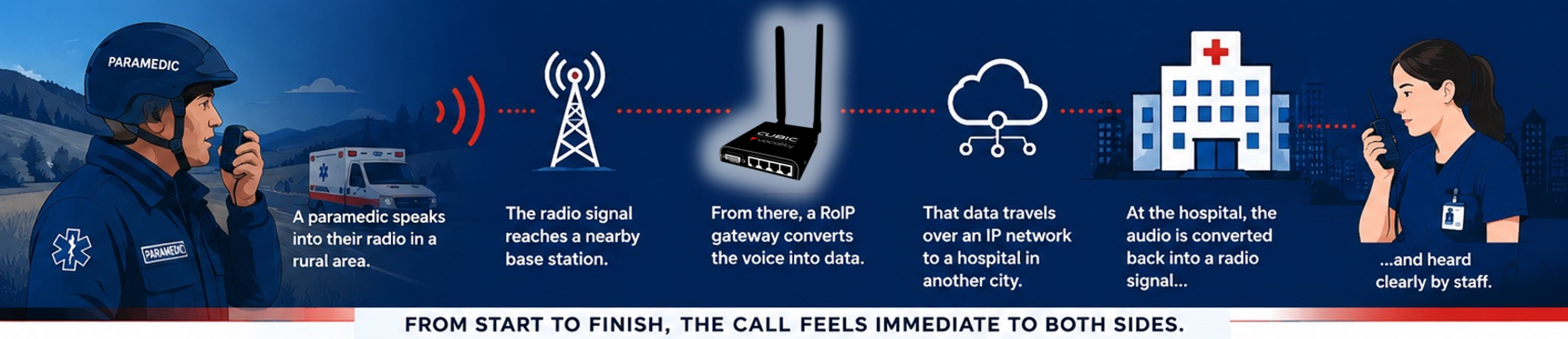
A paramedic speaks into their radio in a rural area. The radio signal reaches a nearby base station. From there, a RoIP gateway, such as the Vocality RoIP, converts the voice into data. That data travels over an IP network to a hospital in another city. At the hospital, another RoIP gateway converts the data back into a radio signal and is heard clearly by staff.
From start to finish, the call feels immediate to both sides.
You don’t need to understand networking to get the basics, but it helps to know what parts are involved.
These are the handheld, vehicle‑mounted, or base station radios people already use.
This is the bridge. A gateway, such as the Vocality RoIP, sits between the radio system and the IP network. It converts radio audio into data and back again.
This could be the public internet, a private fiber network, a military network, a mobile data link, or a satellite service. The type depends on how secure and reliable the system needs to be.
Many RoIP systems can also connect radio networks to dispatch or control room systems. This allows console operators to manage, monitor, and route radio traffic from one place.
RoIP can also connect traditional radio systems with push-to-talk over cellular services, so radio users and smartphone app users can communicate more easily.
RoIP is common where reliable, wide-area communication is needed.
Emergency services
Police, fire, and ambulance services use RoIP to link control rooms, mobile units, and backup locations. If one site goes down, traffic can be rerouted quickly.
Defense and security
Military and security organizations use RoIP to connect radios across ships, vehicles, command centers, and field units, often across different radio types.
Critical infrastructure
Airports, utilities, transport operators, and industrial sites use RoIP to keep teams connected across large areas without building new radio networks.
Lack of interoperability can be a significant challenge for push-to-talk radio users. In plain English, that means different radio systems cannot always talk to each other.
Different teams often use different radio types, manufacturers, and frequencies. Police, fire, ambulance, defense units, contractors, and local authorities may all have reliable radio systems, but those systems may not connect. In an emergency or joint operation, that can become a problem quickly.
RoIP helps solve this.
RoIP sits between radio systems and helps bridge the gap between them.
Each radio system connects to a RoIP gateway. Once the voice is converted into IP data, the original radio type matters less. The call can then be passed to another connected radio system, even if it uses different equipment or frequencies.
For example, Vocality RoIP supports two useful approaches:
Local cross-banding, where different radio systems connect to the same RoIP gateway so nearby teams can work together while keeping their own equipment.
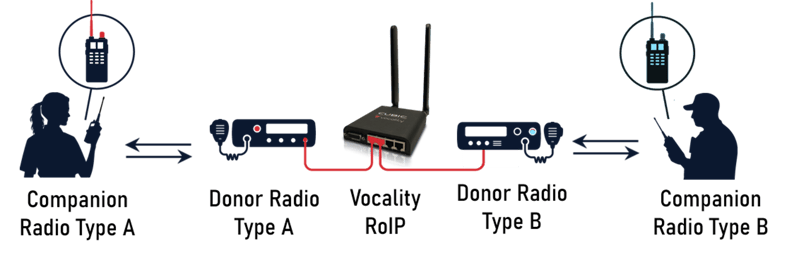
Cross-banding over the internet, where radio systems in different locations are connected over an IP network.
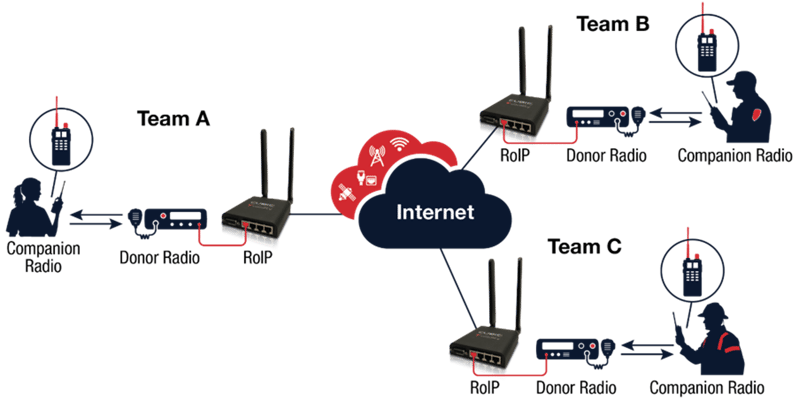
That means:
The radios do not need to change. RoIP creates a bridge between them.
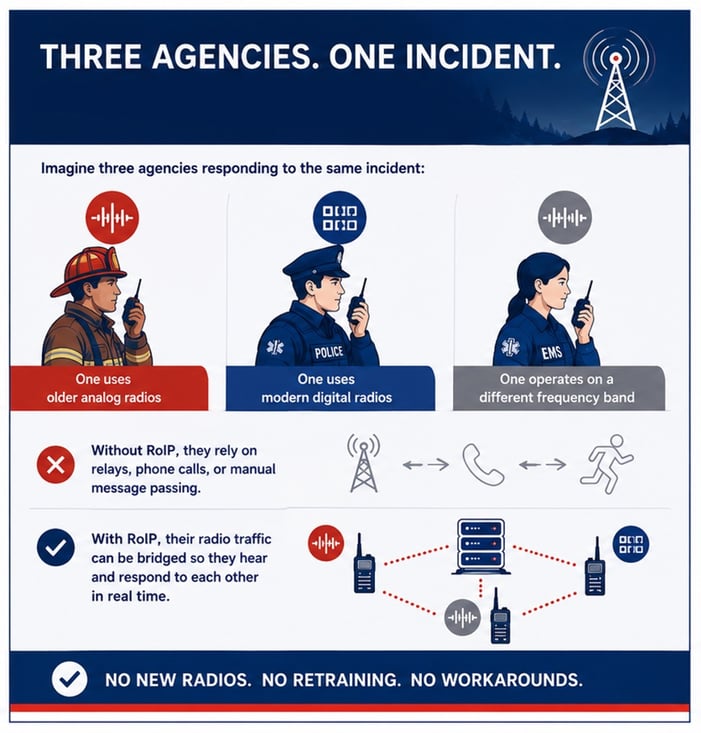
Imagine three agencies responding to the same incident:

Without RoIP, they rely on relays, phone calls, or manual message passing. With RoIP, their radio traffic can be bridged so they hear and respond to each other in real time.
No new radios. No major retraining. Fewer workarounds.
Interoperability is about convenience, speed, and clarity.
RoIP allows organizations to:
Systems can stay independent day to day and link up only when needed.
Interoperability doesn’t mean everyone hears everything.
RoIP systems allow operators to:
That control matters just as much as the connection itself.
The appeal isn’t about new radios or flashy features. It’s about practicality.
RoIP helps organizations:
For many users, the biggest benefit is resilience. If one communication path fails, traffic can often be rerouted through another path.
No. It relies on radio.
RoIP doesn’t eliminate traditional radio systems. It ties them together. Radios still handle local communication, which matters when networks fail or when users operate in isolated areas.
RoIP simply removes the distance and interoperability barriers.
Yes, it can be, but security depends on how it’s deployed.
Most professional RoIP systems support encryption, access controls, and private networks. Public internet connections can be used, but critical users usually rely on secure or managed networks instead.
Security isn’t automatic. It’s designed into the system.
If communication matters when things go wrong, RoIP is usually part of the answer.
That includes:
For small teams operating in a single area, traditional radio may be enough. For anything larger, RoIP quickly becomes hard to avoid.
RoIP keeps the familiar strengths of radio while helping solve two of its biggest challenges: limited range and difficulty connecting different systems.
By carrying radio calls over IP networks, organizations can connect people, places, and systems that were not originally designed to work together. The technology stays in the background. The user experience stays familiar. Communication keeps flowing.
When coordination matters, RoIP keeps communication simple, fast, and controlled.
And in situations where seconds matter, that’s the whole point.
To learn more about the Vocality RoIP Gateway, CLICK HERE
RoIP stands for Radio over IP. It means radio voice traffic is carried over an IP network rather than relying solely on traditional radio coverage.
The main purpose of RoIP is to extend radio communication over longer distances and connect radio systems that would otherwise be separate.
A RoIP gateway is the device that connects a radio system to an IP network. It converts radio audio into digital data, sends it across the network, and converts it back into radio audio at the other end.
VoIP carries phone calls over IP networks. RoIP carries push-to-talk radio communications over IP networks and preserves radio functions such as talkgroups, dispatch control, and radio-to-radio communication.
Yes. RoIP can help connect different radio systems, manufacturers, frequencies, and locations, depending on the gateway, network, and system design.
Yes. RoIP is commonly used by emergency services, defense, security, transport, utilities, and other organizations that need reliable communication across teams, locations, and radio systems.
RoIP is important for interoperability because it helps different radio systems, agencies, frequencies, and locations communicate through a shared IP network while keeping control over who can connect.