

Why do Interoperability Gaps Still Exist?
A Simple Guide to Seamless Public Safety Communication
Introduction: A Critical Disconnect in a Crisis
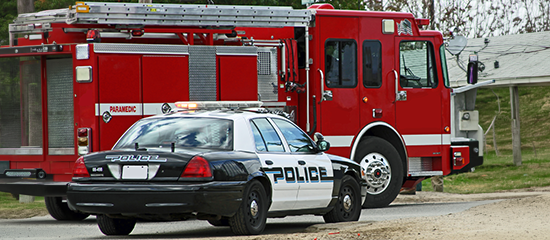
Imagine a wildfire roaring through a remote forest or a hurricane making landfall in a major city. On the scene are multiple agencies: local firefighters, state police, EMS paramedics, and federal disaster response teams. Their mission is clear: save lives and property, and success depends entirely on precise, real-time coordination. One of the key elements is the ability to communicate in real time. Without proper planning and the utilization of specific solutions, the fire chief can’t speak directly to the helicopter pilot, and the federal team can’t coordinate with the local sheriff. They are isolated by their own technology.
Why is it that in an age of instant global connectivity, first responders on the same street often can't talk to each other?
The Problem: Different Radios, Different Languages, and Evolving Technologies
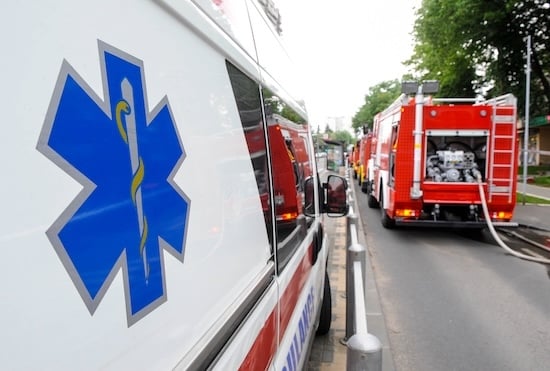
The core of the problem is "technological fragmentation and evolution." For decades, individual public safety agencies have independently purchased their own radio systems.
In addition, there is a proliferation of over-the-top Push-to-Talk over LTE solutions. The result is a patchwork of incompatible equipment and technologies.
This challenge is solved by achieving interoperability, which is the ability for public safety agencies to communicate directly with one another during an emergency, regardless of the type of radio equipment or frequency band they use. When interoperability is absent, the consequences can be catastrophic.
Real-World Consequences of a Communication Breakdown
Hurricane Katrina (2005): During the storm, the New Orleans Police Department's radio system collapsed, isolating hundreds of officers. When state and federal agencies arrived to help, their incompatible radio systems prevented them from communicating with local responders. This led to a devastating breakdown of command and control that tragically delayed rescue efforts and compounded the chaos.
Butler, PA, Assassination Attempt (2024): In a high-stakes security operation, the Secret Service, Pennsylvania State Police, and local law enforcement were all on site. However, they were using different radio frequencies, creating a critical communication gap that hindered their ability to share real-time information and coordinate their response in a life-or-death situation.
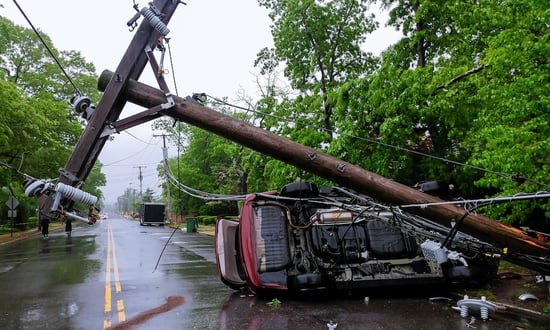
These incidents reveal a persistent, systemic vulnerability: without a way to bridge these technological divides, responding agencies are often left flying blind, undermining mission success and putting lives at risk. Man-made and natural disasters have increased in frequency; however, Standard Operating Procedures (SOPs) and Inter-Agency communications preparedness for unplanned events have not evolved sufficiently to include interoperable solutions designed to mitigate these challenges. Interoperability gaps are a part of the daily fabric of communications and are present during planned and unplanned, sometimes catastrophic events.
How Technology Builds a Bridge: Understanding Radio over IP (RoIP)
To address incompatible radios, engineers developed a set of technologies that merge analog audio with IP sources, solving a multitude of interoperability problems. Understanding these key terms is the first step to seeing how the solution works.
|
Term |
Simple Explanation & Analogy |
|
Land Mobile Radio (LMR) |
Professional-grade two-way radios that are used by police and fire departments. |
|
Radio over Internet Protocol (RoIP) |
Technology that uses an internet connection to link different radio systems. It acts as a digital bridge or a universal translator, converting one radio's "language" into a format any other radio can understand. |
|
Push-to-Talk over Cellular (PTToC) |
Technology that turns a smartphone into a two-way radio using the cellular network. It’s like a walkie-talkie app on your phone, letting you talk to a radio group with the press of one button. |
The Solution: The Vocality RoIP Gateway
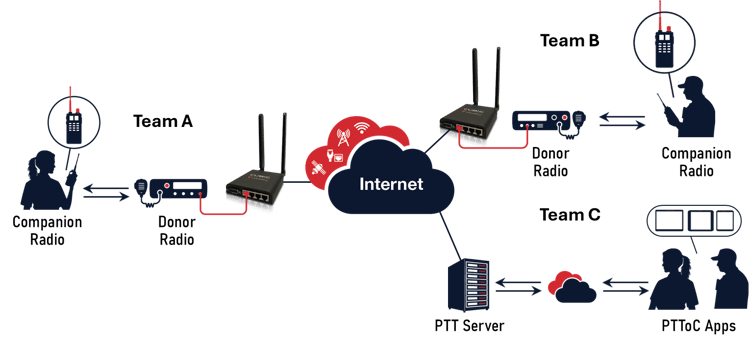
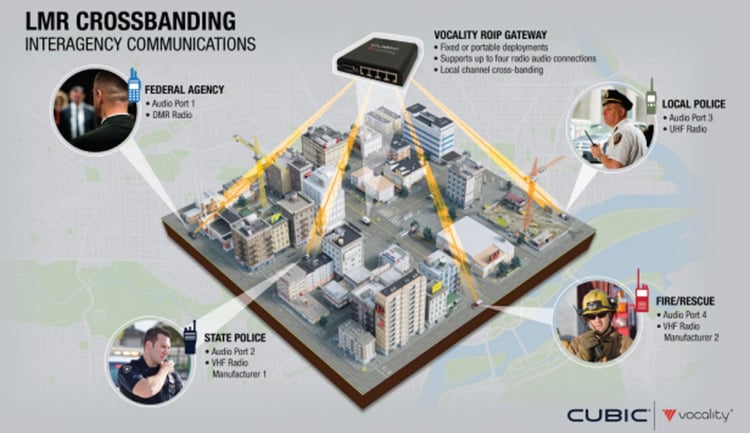
The Vocality RoIP is a low-size, weight, and Power (SWaP) device that acts as a bridge for radios, connecting disparate communication systems into one or multiple audio channels.
The concept is simple and works in three steps:
1. Connect: The Vocality RoIP gateway is indifferent to the type of radio being used. Normally, incompatible radios (VHF, UHF, P25, etc.) are plugged into the Vocality RoIP gateway device.
2. Unify: The Vocality RoIP gateway takes the audio from each radio, converts it into data, and connects local radios or sends it over an IP network (like a cellular or satellite connection) to expand or combine geographically separate networks.
3. Communicate: A unified talk channel is created where everyone, regardless of their original radio type, can hear and speak to each other in real-time.
This gateway solution is specifically designed for the chaos of an emergency scene, with three critical features that make it so effective.
• Rapid and Simple - It can be deployed in minutes and managed through a simple web interface from a computer or tablet. First Responders don't need an engineering degree to get it working; they can connect radios and create talk groups with just a few clicks.
• Portable and Flexible - Vocality RoIP gateway comes in a small, lightweight form factor, and can be included in person-portable backpacks, vehicle-mounted solutions, and transit cases. This ensures they can be taken to any incident location, from a dense urban center to a remote wilderness.
• Low Power Needs - With power consumption as low as 5 watts, the Vocality RoIP can run for hours on small batteries or even a simple USB power bank. This is essential in disaster zones where electricity is often the first utility to fail.
This powerful, portable device provides the missing link. But how does it perform in a real-world disaster?
Putting It All Together: A Wildfire Response
As part of a pilot program funded by the Bipartisan Infrastructure Law, the Bureau of Land Management (BLM) is tackling the classic interoperability challenge faced during large-scale wildfire responses. A single incident involves multiple teams that cannot talk to each other:
• Ground crews use standard VHF/UHF radios.
• Air support (helicopters and air tankers) operates on separate aviation frequencies.
• Command centers use modern P25 digital radio systems.
To solve this, the BLM deployed a communication kit built around the Vocality RoIP gateway. The gateway was used to connect all these disparate systems: ground, air, and command, creating a single, unified communication platform where everyone could talk to each other seamlessly.
The value of this solution was proven during a wildfire in Oregon. An air tanker crashed in the middle of the operation, a moment when clear, instant communication is paramount. Because the unified communication system was already in place, all personnel on the ground and in the air were able to coordinate their response immediately. This pre-established interoperability was critical, enabling an immediate, coordinated response that ensured personnel safety and allowed the mission to continue without missing a beat.
By using Vocality RoIP technology, a chaotic, fragmented response was transformed into a coordinated, safer, and more effective one, proving that with the right tools, first responders can just talk.
To learn more about how Vocality can unify public safety communications,
visit https://vocality.cubic.com/first-responder
Useful Resources
Hurricane Katrina (2005) Select Committee hearing report:
https://govinfo.library.unt.edu/katrina/communications.pdf
Report of the Independent Review Panel on the July 13th, 2024, Assassination Attempt in Butler, Pennsylvania:
Bureau of Land Management (BLM) Communications Award:
https://www.blm.gov/press-release/blm-awards-276-million-contract-advanced-wildfire-communication-kits-part-investing